Milestone twin separation a success
Specialist team separate conjoined twins at Centurion hospital.
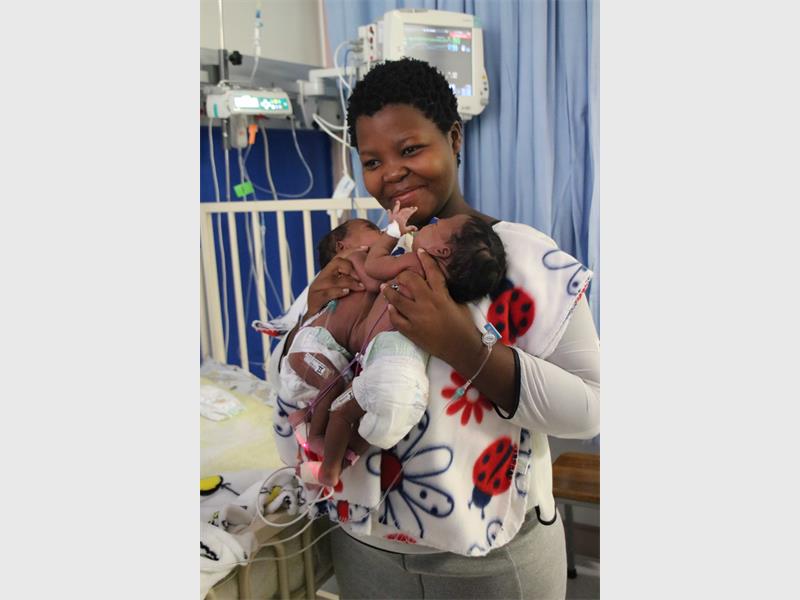

A PAIR of conjoined twins from Big Bend, in Swaziland, underwent a successful six-hour separation operation at Netcare Unitas Hospital, in Centurion, on January 21.
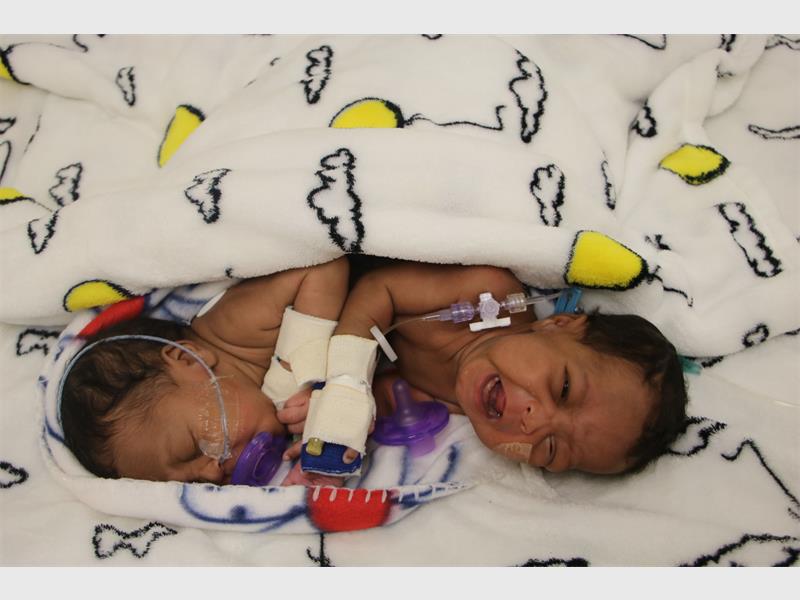
The twin girls, Uwenzile and Uyihlelile Shilongonyane, who together weighed 4.21 kilograms at birth and were joined at the abdomen, were born on January 2 to 19-year-old Bongekile Simelane and her husband, Mbongeni Shilongonyane.
Speaking ahead of the procedure, paediatric surgeons Dr Mariza de Villiers and Dr Paul Stevens agreed that the twins had a good prognosis.
“This type of conjoined twins are known as omphalopagus twins, which means they are joined at the lower abdomen and do not share a heart,” they noted. “Pre-operative assessments indicated that the babies also did not share any other vital organs. This considerably improved their chances of surviving the surgical separation and will also contribute greatly to them leading healthy lives going forward,” said Dr de Villiers.
The Shilongonyane girls are the second set of conjoined twins that Drs de Villiers and Stevens have separated and are the first to have their separation surgery done at Netcare Unitas Hospital. The paediatric surgeons were assisted by Dr Francisca van der Schyff and Dr Kagiso Batka.
Dr de Villiers said that the twins were joined only by a bridge of skin, which made the operation simpler than if they shared vital organs. “There are always considerable risks when separating conjoined twins, but we have been cautiously optimistic all along that the operation would have a good outcome for both twins,” she observed.
“The fact that there was a skin bridge between them, meant that there was sufficient skin to close the resultant surgical wound on each baby without the need for plastic surgery.”
According to Dr Stevens, one of the main challenges the surgical team anticipated ahead of the procedure, related to the anaesthesia. “The twins were conjoined in such a way that they are facing each other. Intubation for such tiny babies is delicate enough, but as their faces were so close together and they were not able to be placed on their backs to be intubated for anaesthesia, this was a great deal more complicated than usual.”
As a result, four anaesthetists participated in the procedure – two per twin cared for the babies for the duration of the surgery. The doctors worked in two distinct teams, identified by their pink and purple surgical scrub caps. The all-female team of anaesthetists consisted of Dr Henrika Rossouw, Dr Sandra Spijkerman, Dr Marleen Odendaal and Dr Jeanri Smith. The little patients were matched to their team by wearing corresponding colours and were connected to their own, colour-coded anaesthetic machine.
The initial stage of the procedure, which was dedicated to getting the anaesthetic just right for the surgery, took more than three hours, which meant that it took almost half of the total theatre time.”
Uwenzile and Uyihlelile were born by caesarean section. Bongkile and Mbongeni are also parents to twin boys, aged two. According to Bongkile, until the seventh month of her pregnancy she had no idea that she was about to give birth to a second set of twins. “At first I was not happy to hear that I was expecting twins for the second time,” she recalls.
“However, once they were born everything changed. After their birth I was at first not worried as I thought the babies were only attached at the umbilical cord. I love my babies so much,” said a tearful and nervous Bongkile as the babies were taken into theatre.
The young couple drew considerable strength from Portia Mabuela, an enrolled nurse at Netcare Unitas Hospital, who has become very close to the family. Even though she was off duty, Portia came in specially to be with the family during this challenging time. “Bongkile was concerned about the well-being of their babies, especially as she could not be with them in theatre and was unable to feed them as per their normal feeding schedule,” said Mabuela.
“We are all so impressed with the ease with which this young mother has been handling her conjoined babies, considering the difficulty in doing something as basic as picking them up,” commented general manager of Netcare Unitas Hospital Robert Jordaan.
“The operation involved a team of eight doctors and a theatre team of 11 nursing professionals. Most of the team members were women. This is a proud moment for Netcare Unitas Hospital and especially for our team of expert doctors and nurses who participated in this operation. What happened here today represents a milestone in the medical history of our facility,” he added.
For free daily local news in the south, visit our sister newspapers Alberton Record, Comaro Chronicle, Southern Courier and Get it Joburg South Magazine.
Remember to visit our Facebook, Twitter and Instagram pages. You can also email our offices on cvdwalt@caxton.co.za, juliem@caxton.co.za or luckyt@caxton.co.za
Add us on WhatsApp today! Comaro Chronicle: 079 427 8074 and Southern Courier: 079 404 5789.