
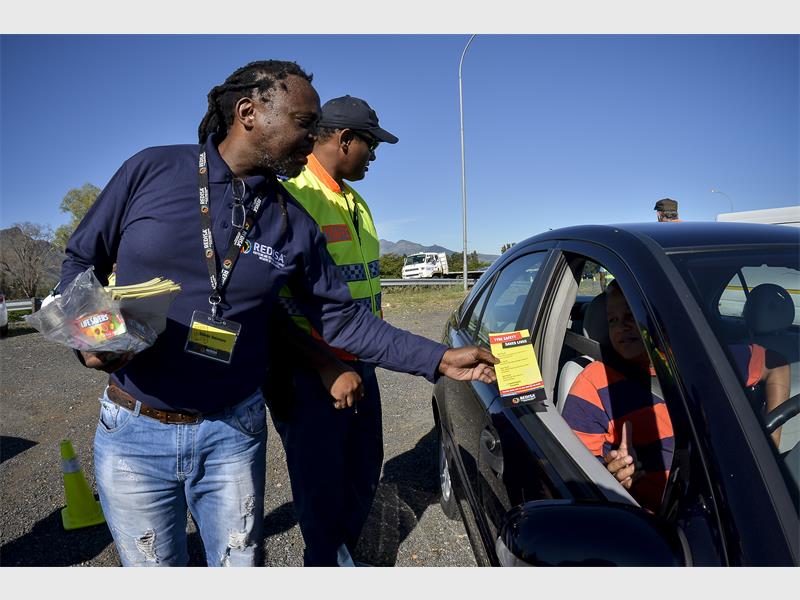

FOR those planning to travel long distances by car during the holiday season, tyre safety should be a top priority.
According to Arrive Alive, failure to attend to tyre safety is a vital factor in thousands of road accidents every year.
Furthermore, findings by the Council of Scientific and Industrial Research (CSIR) indicate that nearly 20 per cent of accidents involving minibuses have tyre failure as a contributing factor.
It won’t help if you have the best brakes on the market if your tyres are worn.
Stacey Davidson, director at REDISA (Recycling and Economic Development Initiative of South Africa), says there are small habits that motorists can adopt to help them remain safe on the roads. These include checking tyres regularly for punctures, cuts and bulges. You also need to take extra care when travelling during the holiday period because of increased traffic volumes, congestion, fatigue and people driving in unfamiliar environments. It is important to be courteous and to take frequent breaks when driving long distances.
Davidson believes that improving driving habits and tyre maintenance will go a long way towards saving lives during the Easter period. Well-maintained tyres will hold your vehicle securely on the road, allowing it to stop, start and manoeuvre safely. Before you get into your car and head to your destination, follow these tips to make your travel a safe and pleasurable experience for you and others on the road.
1. Check your tyre pressure on a cold start or before a long journey.
You’ll find the correct pressure for your vehicle in your operating manual, under your fuel cap, on the inside of the door or in the cubbyhole.
2.If your tyre’s side wall is damaged, replace it.
Check regularly for any signs of irregular wear, any sharp objects lodged in the tread and any cuts, tears, cracks or bulges. Check for damage or uneven wear on all four tyres, on both sides of the tyre and on the wheel rims.
3.Under-inflated tyres use more fuel, so check the pressure.
You’ll need an accurate pressure gauge. Take off the dust cap on the valve, fix on the pressure gauge and make a note of the result. If your tyre needs extra air, you should inflate it using an air pump at home. Under-inflated tyres use more fuel. If the tyre is over-inflated according to the pressure chart, you can allow air to escape whilst the dust cap is off.
4. Check that your tyre pressure is correct and equal.
Never rely on the eyeball method to gauge air pressure in tyres. Next to the vehicle’s brakes, the tyres are the most important safety parts of your car. If there is an imbalance in the tyre pressure there could be a risk when braking and negotiating corners. In addition to putting you at risk of an accident, poor tyre pressure can also affect fuel economy, comfort and the life of the tyre.
For free daily local news in the south, visit our sister newspapers Alberton Record, Comaro Chronicle, Southern Courier and Get it Joburg South Magazine.
Remember to visit our Facebook, Twitter and Instagram pages. You can also email our offices on cvdwalt@caxton.co.za, juliem@caxton.co.za or luckyt@caxton.co.za
Add us on WhatsApp today! Alberton Record: 060 644 5264 Comaro Chronicle: 079 427 8074 and Southern Courier: 079 404 5789.