
Arum Lily – the painter’s choice
Here’s to planting arum lilies and seeing what O’Keeffe was able to see…
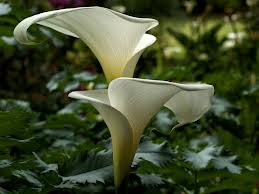

Painter Georgia O’Keeffe’s calla-lily artworks are some of her most distinctive pieces. Depicting the showy plant in all its glory, the artist managed, between the 1920s and 1930s, to create so many paintings with this flower as her subject that she became known as the Lady of the Lilies.
So what is it that O’Keeffe was painting? The calla lily, also known as the arum lily (or varkore in Afrikaans, for its pig-ear resemblance) is a strong, upright plant with a spectacular funnel-shaped spathe (most commonly in white, but with some of its eight species and hybrids occurring in other colours such as pink and yellow) surrounding a yellow, finger-like spadix of tiny flowers. Besides capturing this floral beauty, O’Keeffe appreciated the aesthetic value of the calla lily’s big, bold leaves too.
Formally called Zantedeschia, named after Italian botanist and physician Giovanni Zantedeschi, arum lilies are indigenous to Africa, and can be found growing wildly from South Africa up to Malawi – a spectacular sight to behold when clustered along a green countryside. Its calcium oxalate makes it a poisonous plant, but that doesn’t stop it from being a popularly picked flower – especially as all it takes is one stem to make a massive statement in a vase.
All but one of the Zantedeschia species are tubers. Z. aethiopica, the only rhizome, requires the most watering. For this reason, this specie is most commonly found alongside (sometimes even partially inside) ponds, and so it doesn’t mind waterlogged soils when being planted. The other species require well-draining, humus-rich soil, with a top dressing of old manure in late summer as their flowers are fading, as these tubers should remain in the soil undisturbed for consecutive seasons. When planting, ensure that the tubers are laid flat, with the growing points facing upward. If dividing these tubers, cut them into several pieces, making sure you have at least one eye on each piece.
Zantedeschia should not cause you much trouble. The only thing to look out for is bacterial soft rot, which causes the plant’s tubers to collapse. If you suspect this has occurred, remove the infected tubers, along with the soil surrounding them, and sterilise the spot with a disinfectant so that the rot does not spread to the other tubers in the same soil.
O’Keeffe experienced the calla lily in a very special way. She had a huge appreciation for the floral kingdom, and is known to have said, ‘Everyone has many associations with a flower. You put out your hand to touch it, or lean forward to smell it, or maybe touch it with your lips almost without thinking, or give it to someone to please them. But one rarely takes the time to really see a flower. I have painted what each flower is to me and I have painted it big enough so that others would see what I would see.’
Come see our Facebook page, https://www.facebook.com/hadeco.bulbs, follow us on Twitter @HadecoBulbs, come shop with us at our Online Shop www.hadeco.co.za/shop or visit www.hadeco.co.za for more information.